Introduction
Keyword research has always been the backbone of successful SEO. It helps content creators understand what users are searching for, allowing businesses to optimize their websites for visibility and traffic.
But in 2025, artificial intelligence (AI) is transforming keyword research in ways traditional tools never could. From identifying search intent to analyzing semantic relationships, AI-powered SEO tools are giving marketers deep insights faster than ever before.
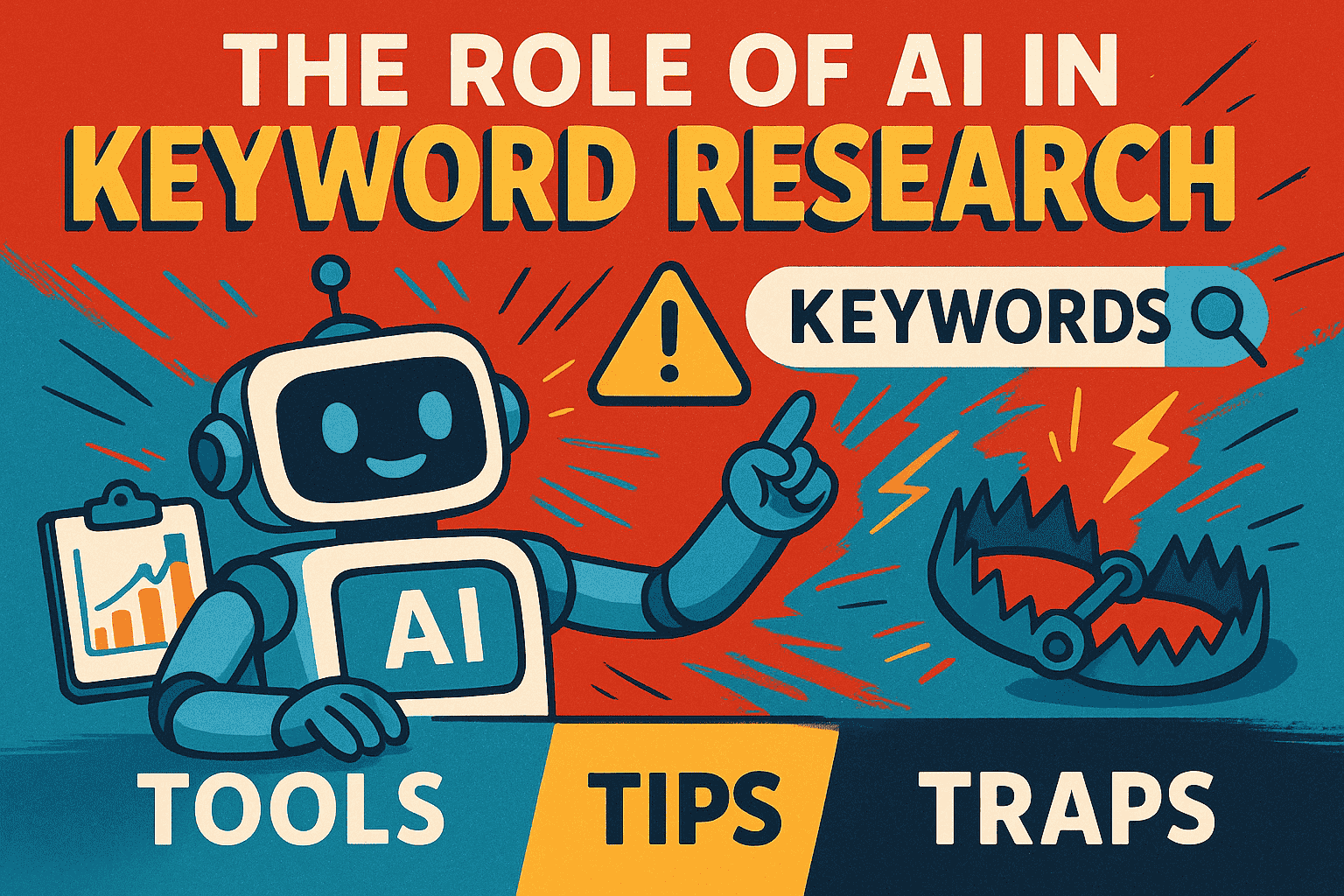
However, while AI can boost accuracy and productivity, it’s not without pitfalls. Let’s explore how AI is reshaping keyword research—along with the tools, best practices, and traps you should avoid.
1. How AI Is Transforming Keyword Research
Traditional keyword tools relied on historical data and search volumes. AI tools go a step further by understanding user behavior, context, and intent.
Instead of just showing keywords with numbers, AI models now:
- Predict trending keywords before they peak.
- Identify topic clusters for better content strategies.
- Analyze semantic connections between related search terms.
- Understand voice search and conversational queries.
This helps marketers focus on what users actually mean, not just what they type.
2. Best AI Tools for Keyword Research in 2025
Here are some of the top-performing AI-powered keyword research tools every SEO professional should know about:
a. Semrush (AI Writing & Keyword Magic Tool)
Semrush integrates AI to predict keyword difficulty and identify long-tail variations with high conversion potential.
Key Features:
- Keyword intent analysis
- AI-based topic grouping
- Competitor keyword mapping
b. Surfer SEO
Surfer SEO uses AI to match content structure with top-ranking pages. It recommends LSI keywords and suggests ideal word counts and headings.
Why Use It: It combines keyword data with content optimization insights.
c. Ahrefs with AI-Powered Suggestions
Ahrefs now incorporates AI-driven keyword intent tagging, helping marketers understand the buyer journey behind each search.
Example: It distinguishes between informational, navigational, and transactional keywords.
d. ChatGPT (via API for SEO workflows)
With GPT-5 integrations, you can use ChatGPT to generate keyword clusters, topic ideas, or semantic keyword variations for any niche.
Use Case: “Generate 20 long-tail keywords for AI content marketing tools.”
e. WriterZen & MarketMuse
Both use AI to build content maps — connecting main keywords with subtopics for in-depth SEO coverage.
You can explore these tools further on Semrush’s AI Suite and SurferSEO’s official website.
3. Tips for Effective AI-Based Keyword Research
AI tools are powerful, but success still depends on how strategically you use them. Follow these tips to make the most of AI in your keyword research process:
1. Focus on User Intent, Not Just Volume
AI tools highlight intent-based searches—words that reflect what the user wants to achieve. Optimize for intent rather than just high search volume.
2. Use Topic Clusters
Instead of focusing on a single keyword, group related keywords together. AI tools like MarketMuse can help identify keyword clusters that improve topical authority.
3. Combine Human Insight with AI Suggestions
AI can suggest thousands of keywords, but human experience is needed to judge relevance and context. Always validate suggestions manually.
4. Analyze Search Trends Regularly
AI models learn fast, but trends evolve daily. Use tools like Google Trends and Exploding Topics alongside AI data for accuracy.
5. Optimize for Voice Search and Natural Queries
With the rise of voice assistants, long-tail, conversational keywords (“how to use AI for SEO”) are more valuable than short ones (“AI SEO”).
4. Common Traps to Avoid When Using AI for Keyword Research
While AI saves time, overreliance can lead to costly mistakes. Watch out for these common traps:
Trap 1: Blindly Trusting AI Data
AI tools sometimes generate keywords that sound logical but have no real search volume. Always cross-check with Google Keyword Planner or Ahrefs.
Trap 2: Ignoring Human Context
AI can’t fully understand tone, emotion, or cultural relevance. A keyword that works in one region might not work in another.
Trap 3: Over-Optimization
Some users overstuff content with AI-suggested keywords. This can trigger search penalties. Focus on natural language flow instead.
Trap 4: Neglecting Competitive Analysis
AI may show easy-ranking keywords, but if top competitors already dominate those terms, you’ll struggle to rank. Combine AI insights with manual SERP research.
5. The Future of AI in Keyword Research
AI keyword research is evolving toward predictive SEO, where algorithms forecast search patterns months before they trend.
Emerging AI systems can:
- Predict seasonal keyword spikes.
- Suggest content calendars automatically.
- Adjust strategies based on search engine algorithm updates.
Soon, SEO will rely less on guesswork and more on data-driven predictions guided by AI.
Final Thoughts
AI has become an indispensable part of keyword research and SEO strategy. It allows marketers to uncover opportunities faster, analyze intent better, and stay ahead of competitors.
However, the secret lies in balance—use AI for insights, but let human creativity and judgment drive the final strategy.
The best SEO campaigns in 2025 will be powered by AI precision and human intuition working together.
Recommended Read
Explore our related guide: Why Traditional SEO Is Dying — and How AI Is Taking Over