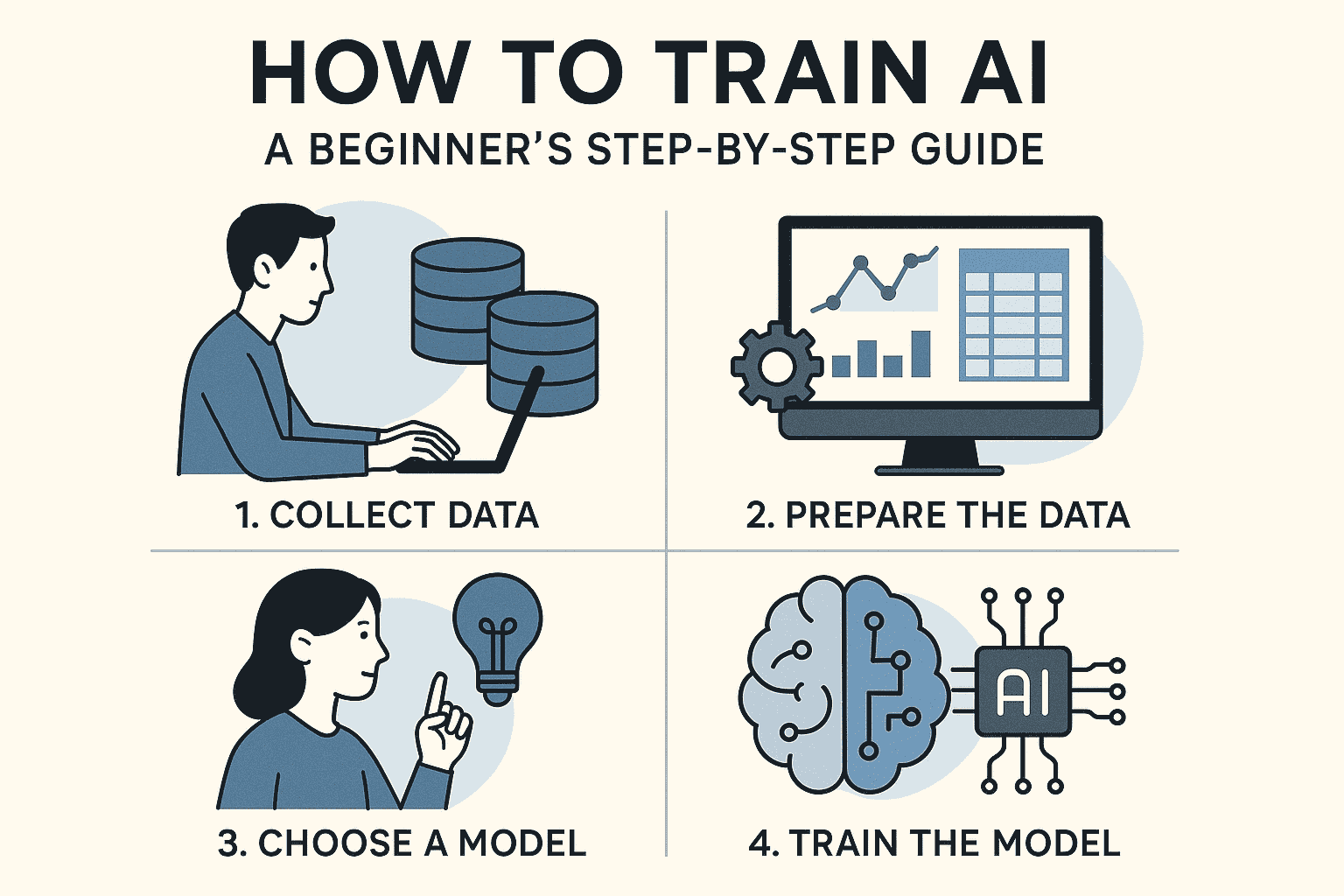
Artificial Intelligence (AI) is reshaping industries, powering everything from recommendation engines on streaming platforms to advanced medical diagnostics. While AI might sound complex, training an AI system follows a structured process that beginners can understand and even start experimenting with. This guide will walk you through the step-by-step process of training AI, breaking down technical jargon into simple, actionable insights.
Step 1: Understand the Basics of AI and Machine Learning
Before jumping into training, it’s important to grasp the core concepts:
- Artificial Intelligence (AI): A broad field focused on creating systems that can perform tasks requiring human intelligence.
- Machine Learning (ML): A subset of AI where systems learn from data instead of explicit programming.
- Deep Learning: A type of ML that uses neural networks to analyze data and make decisions.
Key takeaway: To train AI, you need data, an algorithm (model), and a way to evaluate performance.
Step 2: Define the Problem You Want AI to Solve
AI is only useful when applied to a specific problem. Ask yourself:
- What is the goal? (e.g., predict customer churn, recognize images, recommend products)
- What type of AI is needed? (classification, regression, clustering, NLP, etc.)
- What outcome will define success? (accuracy, reduced costs, better user experience)
By defining your problem clearly, you set the foundation for choosing the right model and dataset.
Step 3: Gather and Prepare the Data
Data is the fuel that powers AI. The better the data, the smarter your AI will be.
- Collect Data: Use existing databases, web scraping, sensors, or open-source datasets.
- Clean Data: Remove duplicates, fix errors, handle missing values, and normalize data.
- Label Data: For supervised learning, ensure data is labeled (e.g., “cat” or “dog” in an image dataset).
- Split Data: Divide into training (70%), validation (15%), and testing (15%) sets.
Pro Tip: High-quality, diverse, and well-labeled datasets improve model performance significantly.
Step 4: Choose the Right Algorithm or Model
Different problems require different AI models:
- Linear Regression: Predict numerical values.
- Logistic Regression: For binary outcomes (yes/no).
- Decision Trees & Random Forests: Great for classification tasks.
- Neural Networks: Useful for image recognition, speech, and complex tasks.
- NLP Models: Handle text analysis, chatbots, and sentiment analysis.
For beginners, tools like scikit-learn, TensorFlow, or PyTorch provide pre-built algorithms you can experiment with.
Step 5: Train the Model
Training is where the model learns patterns from data.
- Feed Data: Input training data into the model.
- Adjust Weights: Algorithms adjust parameters to minimize errors.
- Iterate: The process repeats across multiple training cycles (epochs).
- Hyperparameter Tuning: Adjust learning rate, batch size, and network layers to improve performance.
The more training cycles, the better the model adapts—up to a point. Overtraining can cause overfitting, where the model memorizes instead of generalizing.
Step 6: Evaluate the Model
After training, test how well the AI performs on unseen data.
- Metrics for Classification: Accuracy, precision, recall, F1-score.
- Metrics for Regression: Mean squared error (MSE), mean absolute error (MAE).
- Confusion Matrix: Shows correct vs. incorrect predictions.
Goal: Ensure the model performs well not only on training data but also on real-world test cases.
Step 7: Improve and Optimize
No AI model is perfect after the first run. Common optimization strategies include:
- Feature Engineering: Creating new features from existing data.
- Data Augmentation: Increasing dataset diversity (e.g., rotating images).
- Regularization: Preventing overfitting by penalizing complexity.
- Ensemble Methods: Combining multiple models for better accuracy.
Iterative improvement ensures that the AI model becomes more robust and reliable.
Step 8: Deploy the Model
Once the model meets performance goals, it’s time for deployment:
- Integration: Embed the AI model into applications or systems.
- APIs: Use frameworks like Flask or FastAPI to deploy models as services.
- Monitoring: Track real-time performance and retrain when necessary.
Deployed models need constant monitoring and updates, as real-world data often evolves over time.
Step 9: Maintain and Retrain
AI is not “train once and forget.” Continuous updates keep the model relevant:
- Retrain with New Data: Periodically update with recent datasets.
- Monitor Drift: Watch for changes in data patterns (data drift).
- Version Control: Track model versions for reproducibility.
Long-term maintenance ensures AI systems remain accurate, reliable, and trustworthy.
Beginner-Friendly Tools for Training AI
- Google Colab: Free cloud-based platform to run Python code.
- Scikit-learn: Beginner-friendly ML library.
- TensorFlow & PyTorch: Popular frameworks for deep learning.
- Keras: High-level neural network API built on TensorFlow.
- OpenAI APIs: Pre-trained models for NLP, text, and image tasks.
These tools reduce complexity, making AI accessible even for beginners.
Common Challenges Beginners Face
- Insufficient Data: Small datasets can lead to poor performance.
- Overfitting: Model performs well on training but fails on test data.
- Complex Algorithms: Choosing overly advanced models too early.
- Hardware Limitations: Some deep learning models require GPUs.
- Bias in Data: Poorly labeled or skewed data introduces bias.
Awareness of these challenges helps beginners avoid costly mistakes.
Conclusion
Training AI may seem intimidating, but by following a structured, step-by-step process, beginners can build and deploy functional AI models. From defining the problem and preparing data to selecting models, training, and deployment, each stage plays a vital role in creating a reliable AI system.
With practice, experimentation, and continuous learning, anyone can master AI training and contribute to the future of intelligent technology.